Minnesota employers are navigating a changing leave landscape with the introduction of Paid Family and Medical Leave (PFML) in 2026. A common question is how PFML fits alongside Workers’ Compensation (WC).
At a high level, Workers’ Compensation and PFML are separate programs with different purposes, but they are designed to work alongside one another, not in competition.
Understanding the basic concept of how they interact can help employers communicate more clearly with employees and reduce confusion.
Different Programs, Different Purposes
Workers’ Compensation (WC)
Workers’ Compensation exists to support employees who experience injuries or illnesses related to their job. It focuses on workplace incidents and provides benefits connected to medical care, recovery, and return to work.
Paid Family and Medical Leave (PFML)
Minnesota’s PFML program is a state‑run paid leave benefit that helps employees take time away from work for serious health or family‑related reasons, whether or not those reasons are connected to the workplace.
While both programs may result in time away from work, they were created for different reasons and are governed by different systems.
How WC and PFML Fit Together Conceptually
At a high level:
- Workers’ Compensation is generally the primary program for work‑related injuries
- PFML is generally used for non‑work‑related medical or family leave needs
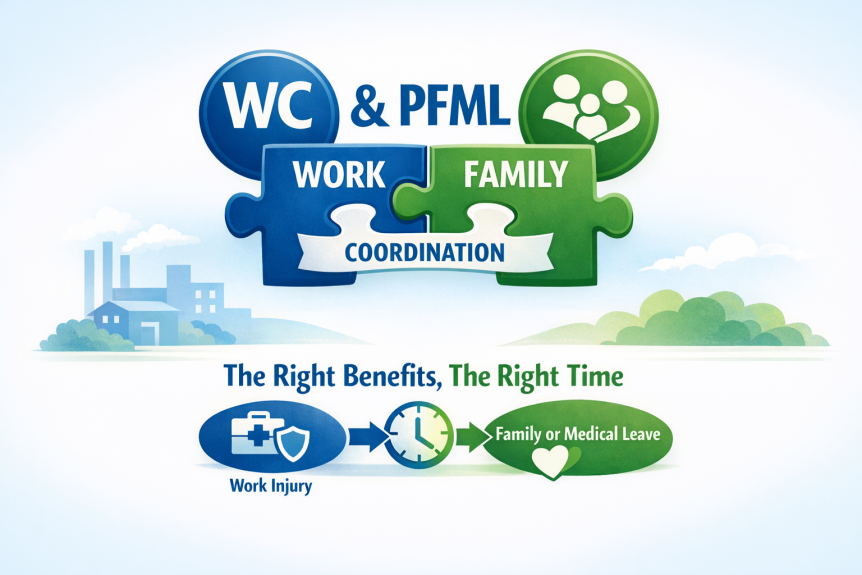
PFML is not intended to replace Workers’ Compensation, and Workers’ Compensation does not replace PFML. Instead, the programs are designed to coordinate so employees are supported without overlapping benefits for the same absence.
Can Workers’ Compensation and PFML Run Concurrently?
At a high level, WC and PFML are not designed to fully “run together” in the traditional sense, but there are situations where both programs may be relevant during the same general period of time.
This is best understood as coordination rather than true concurrency.
How “Concurrency” Happens Conceptually
In real life, employee leave situations are not always tied to a single issue. Because WC and PFML serve different purposes, there are times when:
- An employee may be interacting with both systems at once, or
- One program applies while the other is evaluated, paused, or limited
From an employer or employee perspective, this can feel like both programs are “running,” even though they are addressing different aspects of the absence.
Common High‑Level Scenarios
Without getting into specifics, WC and PFML may overlap conceptually when:
- An employee has more than one reason for being away from work
- A work‑related injury exists alongside a separate medical or family leave need
- One program addresses injury‑related benefits, while the other is relevant to leave designation or job protection
In these situations, both programs may be part of the conversation — even if only one is providing wage replacement at a time.
What Typically Does Not Happen
At a high level, Minnesota’s systems are structured so that:
- Employees are not intended to receive duplicative wage replacement
- PFML is not meant to replace Workers’ Compensation
- Workers’ Compensation remains the primary program for work‑related injuries
The focus is on using the appropriate program for the appropriate reason, rather than stacking benefits.
Why Coordination Matters
From an employer perspective, coordination helps:
- Prevent employee confusion
- Support consistent leave communication
- Reinforce that different benefit programs serve different roles
From an employee perspective, coordination helps:
- Clarify which program applies
- Set expectations around leave and pay
- Reduce uncertainty during already stressful situations
At a conceptual level, the goal is simple: the right program applies at the right time.
A Simple Way to Explain It
For employer communication, a safe and effective way to frame this is:
“Workers’ Compensation and PFML are separate programs. In some situations, both may be relevant during the same time period, but they are coordinated so benefits are not duplicated.”
This approach keeps the conversation:
- High‑level
- Accurate
- Easy to understand
The Big Picture
Minnesota’s Workers’ Compensation system and Paid Family & Medical Leave program are both designed to support employees during times when they cannot work — for different reasons and in different ways.
When viewed at a high level, these programs:
- Are complementary, not duplicative
- Serve distinct purposes
- Help create a more comprehensive safety net for Minnesota workers
Keeping the focus on concept, intent, and communication allows employers to stay aligned without overcomplicating the conversation.